Editing for Clarity and Conciseness: How to Write Less and Say More

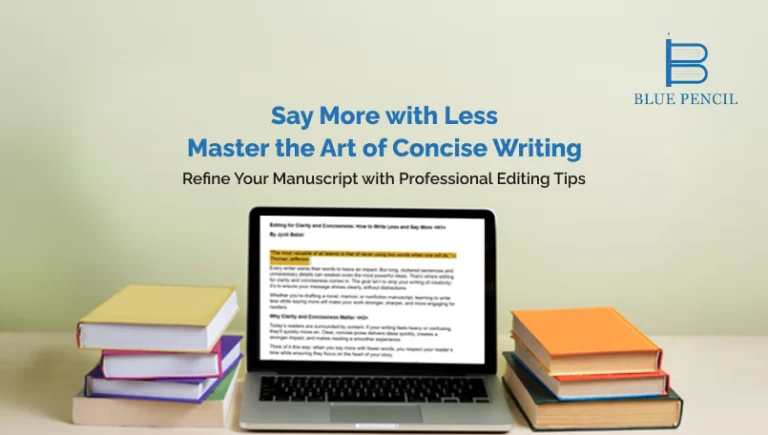
Editing services to improve clarity and conciseness with professional feedback
Editing for clarity and conciseness helps writers sharpen their message, making every word impactful and engaging for readers.

By Jyoti Babel

“The most valuable of all talents is that of never using two words when one will do.” – Thomas Jefferson

Every writer wants their words to leave an impact. But long, cluttered sentences and unnecessary details can weaken even the most powerful ideas. That’s where editing for clarity and conciseness comes in. The goal isn’t to strip your writing of creativity; it’s to ensure your message shines clearly, without distractions.

Whether you’re drafting a novel, memoir, or nonfiction manuscript, learning to write less while saying more will make your work stronger, sharper, and more engaging for readers.

Why Clarity and Conciseness Matter

Today’s readers are surrounded by content. If your writing feels heavy or confusing, they’ll quickly move on. Clear, concise prose delivers ideas quickly, creates a stronger impact, and makes reading a smoother experience.

Think of it this way: when you say more with fewer words, you respect your reader’s time while ensuring they focus on the heart of your story. 

Good editing ensures that every word earns its place on the page. By removing redundancy and sharpening expression, you make your story or argument easier to understand and more memorable.

The Pitfalls of Wordy Writing

Even experienced writers struggle with overwriting. You may not realize you’re explaining the same point twice, using overly complex words, or stringing together sentences that could be simplified.

Some of the most common traps include redundancy (“each and every”), overexplaining details, using complicated phrasing when simpler words work better, and packing too many ideas into a single sentence. These habits cloud your message and weaken its impact.

Editing for Clarity

Clarity means your ideas are easy to understand. Readers shouldn’t have to work to figure out what you’re saying.

To achieve this, focus on your main point and cut distractions. Simplify language where possible, and don’t be afraid to break a long sentence into two shorter ones. Writing in active voice also helps your words feel more direct and energetic.

For example:

Wordy: She was very tired because she had stayed up very late the previous night finishing her manuscript.

Clear: She was exhausted after staying up late to finish her manuscript.

Edits like this make your sentences more vivid, easier to read, and more engaging for your audience.

Editing for Conciseness

Conciseness is about making every word count. Instead of piling on modifiers or repeating ideas, choose words that carry precision and strength.

Look out for filler words like really, very, or just. Trim redundancies, such as “end result,” when “result” alone is sufficient. Cut what doesn’t serve the story.

Concise writing doesn’t strip your personality; it highlights it. By removing clutter, your unique voice and message become sharper and clearer.

The Benefits of Concise Writing

Clear and concise prose offers several benefits. It strengthens the impact because each sentence carries weight. It improves pacing, making your manuscript easier to read. And it creates a professional finish that agents, publishers, and readers will immediately notice.

Concise writing also builds trust with your audience. When you express yourself efficiently, readers feel respected and valued, which makes them more likely to stay engaged.

Self-Editing Tips for Writers

Before handing your manuscript to a professional, you can take steps to tighten your work. 

  • Reading aloud helps you catch awkward phrasing. 
  • Taking breaks gives you fresh eyes, making it easier to spot what can be trimmed.
  • You can also ask for feedback from trusted readers. Often, someone else will notice when a sentence feels too long or a paragraph repeats an idea. 
  • Editing tools can help, but they should supplement your judgment, not replace it.

Why Professional Editing Matters

Self-editing will only take you so far. A professional editor brings objectivity, skill, and experience that writers can’t always apply to their own work. They see the big picture, identify weaknesses, and refine your manuscript so it reads smoothly from start to finish.

If you’re looking for book editing services, a professional editor won’t just correct grammar; they’ll strengthen structure, enhance style, and polish your manuscript for publication. If you only need the final check, book proofreading ensures no errors slip through.

In either case, professional editing services for writers make your work shine while preserving your unique voice.

Editing for Every Stage of Writing

Every manuscript benefits from editing, but the type of editing you need depends on where you are in your writing journey. 

  • Developmental editing helps shape your ideas and structure. 
  • Copyediting refines grammar, word choice, and flow. 
  • Proofreading catches final errors before publishing.

Together, these form book editing and proofreading services that give your manuscript a professional edge. Skipping this step risks distracting readers with mistakes or losing their attention with clutter.

Writing less to say more is one of the most powerful tools a writer can master. Clarity and conciseness aren’t about cutting creativity; they’re about making space for your voice to shine through.

By focusing on what matters and working with the right editor, you’ll not only improve your current manuscript but also grow as a writer. When every word counts, your readers will notice and they’ll thank you for it.

How Blue Pencil Publishers Can Help

At Blue Pencil Publishers, we believe that strong editing makes strong stories. Our team works closely with writers to refine manuscripts while preserving the essence of their unique voice. From developmental feedback to detailed copyediting and final proofreading, we offer services tailored to meet your specific needs.

Whether you’re preparing your first novel or your latest nonfiction project, our editors ensure your words are clear, concise, and impactful. With the right guidance, your story won’t just reach readers; it will resonate with them.

Partner with Blue Pencil Publishers today and let us help you transform your manuscript into one that truly shines.

Request a Professional Editing Consultation

More to read on Blue Pencil:

Why Do You Need a Professional Editor?

Why Hiring a Professional Editor Frees You Up

When You Say ‘Editing’, What Do You Mean?

JyotiJyoti is a Content Developer and a lover of books, an Engineer by education who finally found her calling in words. Taking long walks, practising yoga, listening to music, meeting a good friend over a cup of tea, baking the perfect cake – all these little things make her happy in their own way. Jyoti enjoys writing on a wide range of topics, but her favourites are food, books, travel, and culture.

The Psychology of Editing: Understanding the Reader’s Perspective

Writer reviewing manuscript with notes, focusing on reader engagement and clarity during editing
Editing with the reader’s perspective ensures your manuscript is clear, engaging, and impactful. Discover tips to write with clarity and connection.

By Jyoti Babel

“You can make anything by writing.” – C.S. Lewis

Writing is not merely a way to record thoughts; it is a bridge to readers’ minds and hearts. Every word, sentence, and paragraph carries the potential to engage, inform, or inspire. Yet, even the most compelling ideas can fall flat if they are not presented with the reader in mind. 

Understanding the psychology of reading, the way readers process and respond to text, is essential for effective editing. By approaching your manuscript from the reader’s perspective, you can refine your work to ensure clarity, engagement, and resonance.

Why the Reader’s Perspective Matters

Many writers focus primarily on grammar, syntax, or style, often overlooking the most important audience: the reader. Readers come with prior knowledge, expectations, and emotional responses that influence how they interpret your words. 

A sentence that seems clear to the author may confuse a reader. A paragraph that feels vivid on the page may feel slow or tedious in practice.

Consider, for example, a description of a character’s morning routine:

  • Wordy: The morning sunlight streamed through the window, and the children sat quietly, each holding a book as they read aloud in turn.
  • Reader-focused: Sunlight filled the room as the children read their books aloud.

The revised sentence conveys the same scene but is easier for the reader to process. It respects their attention and allows them to visualize the moment quickly.

By keeping the reader in mind, writers ensure that every word serves a purpose and contributes to the overall experience.

How Readers Process Writing

Readers engage with text cognitively and emotionally. Long sentences, unnecessary jargon, or tangents can increase cognitive load, making comprehension difficult. Similarly, a story that fails to evoke emotions, such as curiosity, empathy, or suspense, may lose engagement. Even subtle issues, such as abrupt transitions between paragraphs, can interrupt the flow and break immersion.

Understanding these dynamics allows writers to edit with intention. For instance, a nonfiction author explaining a complex concept might initially write:

  • Wordy: In order to maximize the efficiency of the workflow, it is necessary that all team members consistently follow the prescribed procedures outlined in the documentation.
  • Reader-focused: To improve workflow efficiency, every team member should follow the documented procedures.

The second version reduces mental strain and communicates the idea directly, allowing the reader to absorb it without extra effort.

Strategies for Reader-Centered Editing

Editing with the reader in mind requires more than trimming sentences; it involves seeing the manuscript through their eyes. 

Start by prioritizing clarity. Each sentence should convey a single idea, avoiding clutter or ambiguity. Active voice often strengthens comprehension by making subjects and actions clear.

Flow is equally important. Readers appreciate logical progression. Breaking complex ideas into smaller paragraphs, using subheadings where appropriate, and guiding the reader smoothly from one idea to the next helps maintain engagement.

Emotional engagement is another critical element. Stories resonate when readers can connect with the characters, scenarios, or arguments. 

In fiction, this might mean showing rather than telling, allowing actions to reveal character traits. 

In nonfiction, anecdotes and examples help readers relate to the material. 

Consider a historical explanation:

  • Wordy: The industrial revolution, which occurred during the late 18th century, brought about profound economic, social, and technological changes that affected populations across Europe and later North America.
  • Reader-focused: In the late 18th century, the Industrial Revolution transformed daily life across Europe and North America, changing how people worked, traveled, and lived.

The revised sentence is more digestible, and it emphasizes the reader’s ability to absorb and visualize the changes.

Avoiding Complexity and Redundancy

Even skilled writers can inadvertently overcomplicate their prose. Redundant phrases, filler words, and long-winded constructions distract readers and dilute impact. 

A simple rule of thumb: every word should earn its place.

Consider:

  • Wordy: At this point in time, the project is in progress and being actively worked on by the team.
  • Concise and reader-focused: The team is actively working on the project.

Editing for conciseness doesn’t mean sacrificing style; it enhances readability and allows your voice to come through more clearly.

The Value of Professional Editing

While self-editing is essential, professional editors offer an objective perspective that writers often struggle to achieve on their own. Expert editors understand book editing services and know how readers process information. They identify unclear passages, structural issues, and inconsistencies that may go unnoticed, refining manuscripts to maximize clarity and engagement.

Professional editing services for writers do more than correct grammar. They enhance flow, refine style, and ensure that each chapter communicates effectively. For writers preparing for publication, book editing and proofreading services guarantee that manuscripts are polished, error-free, and ready to captivate readers.

Understanding the psychology of reading is central to effective editing. Writers who edit with the reader in mind create manuscripts that are clear, engaging, and emotionally resonant. By focusing on comprehension, flow, and emotional impact, you ensure that every word serves a purpose and contributes to a meaningful reading experience.

From Draft to Masterpiece: Editing That Brings Your Story to Life

At Blue Pencil Publishers, we help writers refine their manuscripts with the reader in mind. Our editors provide developmental feedback, detailed copyediting, and final proofreading tailored to your project. Whether you’re preparing your first novel or your latest nonfiction work, our team ensures your words connect, resonate, and leave a lasting impression.

Partner with Blue Pencil Publishers today and let us help you transform your manuscript into one that truly resonates with readers.

Request a Professional Editing Consultation

More to read on Blue Pencil

Print on Demand Books: The Future of Publishing

Self-publish your Book, Reach Your Readers and Gain Access to a World of Infinite Possibilities

When You Say ‘Editing’, What Do You Mean?

JyotiJyoti is a Content Developer and a lover of books, an Engineer by education who finally found her calling in words. Taking long walks, practising yoga, listening to music, meeting a good friend over a cup of tea, baking the perfect cake – all these little things make her happy in their own way. Jyoti enjoys writing on a wide range of topics, but her favourites are food, books, travel, and culture.

The Benefits of Working with a Professional Remote Editor

benefits of a remote editor for writers
Remote editors bring professional insight and flexibility to your writing, no matter where you are in the world.

By Jyoti Babel

“The first draft is black and white. Editing gives the story colour.” – Emma Hill

As a writer, your ideas are your lifeblood, and your words give them shape. But even the best first drafts need a second set of eyes; someone who can refine your narrative, tighten your prose, and bring clarity to your thoughts. That’s where editing comes in, and more specifically, where a remote editor can make all the difference.

The world is digitally connected today, and for the keen, there is no dearth of talent. Writers no longer need to rely solely on local editing resources. Professional remote editors offer professional services virtually that are convenient, efficient, and just as effective as traditional in-person editing. 

Who is a Remote Editor?

A remote editor is a professional editor who works with writers virtually, without in-person meetings. Using digital tools and communication platforms, remote editors review, revise, and refine manuscripts from any location. Whether it’s developmental editing, copyediting, or final proofreading, they offer the same expertise as traditional editors, often with added flexibility and convenience.

Whether you’re writing your debut novel, polishing your memoir, or preparing a manuscript for publication, working with a remote editor can be a transformative step in your writing journey. 

Let us discover how and why.

1. Work with the Right Editor, No Matter Where They Are

One of the most compelling reasons to choose a remote editor is the freedom to work with the best talent, regardless of geography. You’re no longer limited to editors in your city or country. Whether your manuscript is a romance, thriller, or science fiction epic, you can find an editor who has experience in your specific genre and, more importantly, one who understands your voice.

This accessibility is especially helpful for writers in remote areas or non-native English speakers seeking to collaborate with editors who are proficient in global publishing standards. The digital landscape makes top-tier editing expertise just an email or a Zoom call away.

2. Flexible Schedules, Faster Turnarounds 

Time zones are no longer a hurdle; they’re an advantage. While you sleep, your editor may be working. Remote virtual editing often results in faster turnaround times compared to traditional editing pipelines. With clearly defined timelines and progress tracking tools like Google Docs, Dropbox, or editing platforms like Fictionary or Scrivener, the process becomes smooth and transparent.

Busy writers, who juggle multiple responsibilities, also benefit from the flexibility of asynchronous communication. You don’t need to carve out time for in-person meetings. Instead, you can review comments and suggestions on your own schedule, allowing for a more thoughtful and less rushed revision process.

3. Cost-Effective Without Compromising Quality

Hiring a remote editor is often more affordable than in-person editorial support. Without the overheads associated with office space, travel, or printed materials, they can maintain competitive costs while still offering exceptional value.

More importantly, the virtual model allows for customizable services. Whether you need a full structural edit, a line-by-line polish, or a final proofread before publication, you can select services that match your budget and your book’s needs. Writers looking for book editing services often appreciate this flexibility.

4. Editing as a Collaborative, Ongoing Process 

Gone are the days when editing meant handing over a manuscript and waiting weeks to hear back. With virtual editing, the process becomes an active collaboration. 

Cloud-based editing platforms enable real-time feedback and version control, allowing for seamless collaboration and efficient workflow management. Editors can leave comments, suggest changes, and even hop on video calls for deep-dive discussions.

This approach empowers writers to remain involved in the creative decision-making process. You learn through the process, gain clarity on your writing quirks, and develop a better understanding of how your manuscript is perceived by others.

5. More Than Just Grammar and Typos 

A good editor goes beyond spotting grammar mistakes or punctuation errors. They analyze your manuscript for pacing, structure, tone, character development, and narrative consistency. Some also help with preparing your manuscript for agents or self-publishing platforms, giving your book a professional edge.

Whether you’re looking for book proofreading or comprehensive editorial feedback, a skilled remote editor helps elevate your manuscript from “almost there” to “ready for readers.”

6. Protecting Your Work and Your Voice 

A common concern among writers is whether remote editing might compromise their unique voice or vision. But reputable remote editing service providers understand that editing is not rewriting, it’s refining. They aim to preserve your intent while enhancing clarity and impact.

Additionally, professional editors follow strict confidentiality standards and offer contracts to protect your intellectual property. Version histories and cloud backups also help preserve the integrity of your work.

7. Ideal for Every Stage of the Writing Journey

Whether you’re a first-time novelist or a seasoned author, working with a virtual remote editor can fit seamlessly into your writing process. 

Need feedback on your first draft? An editor can help shape your narrative direction. 

Finished your manuscript? They’ll provide a deep edit to polish it.

Final revisions done? It’s time for proofreading.

Writers looking for editing services often discover that editors can support them through every phase, from raw draft to bookstore-ready.

Professional Editing Services You Can Trust 

Writing may be a solitary act, but editing doesn’t have to be. In an era where digital collaboration is the norm, working with a remote editor offers flexibility, quality, and support that every writer deserves.

At Blue Pencil Publishers, we understand the importance of a good editor in the writing process. Our remote editing team brings a wealth of experience in fiction, non-fiction, and academic writing. We offer personalized services tailored to your manuscript’s needs and your publishing goals.

From developmental edits to final proofreading, we’re here to help you fine-tune your work and get it ready for agents, publishers, or self-publishing platforms. Our team delivers book editing and proofreading services that combine professional precision with genuine passion for storytelling.

Let your words matter. Let your voice be heard. And let your story be told with the clarity, strength, and brilliance it deserves, with the right editor by your side.

Ready to transform your manuscript? Partner with Blue Pencil and let your story shine in full color.

More to read on Blue Pencil

Self-Editing vs. Professional Editing: Making the Right Choice for Your Manuscript

When You Say ‘Editing’, What Do You Mean?

Why Hiring a Professional Editor Frees You Up

Why Do You Need a Professional Editor?


JyotiJyoti is a Content Developer and a lover of books, an Engineer by education who finally found her calling in words. Taking long walks, practising yoga, listening to music, meeting a good friend over a cup of tea, baking the perfect cake – all these little things make her happy in their own way. Jyoti enjoys writing on a wide range of topics, but her favourites are food, books, travel, and culture.