
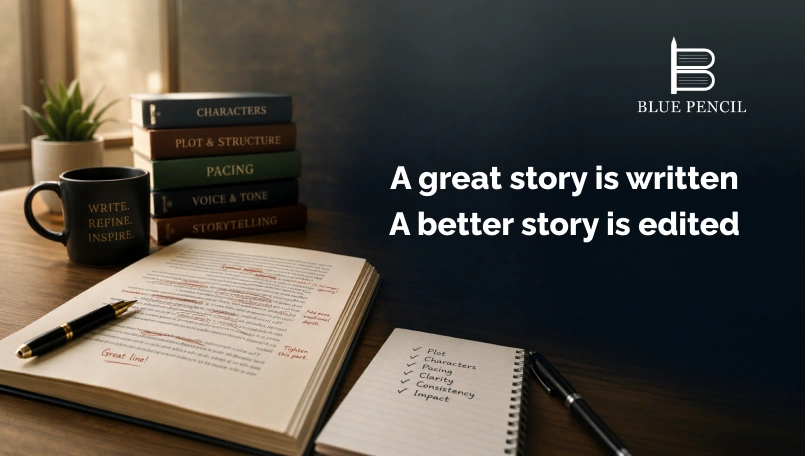
Book editing is about more than correcting grammar and punctuation. It helps authors strengthen their storytelling by refining characters, pacing, plot, and narrative flow while preserving their unique voice. Before your manuscript is ready for publication, here are some of the key elements every writer should consider.
Crafting a compelling narrative
A book must catch the readers’ attention and keep them engaged in the story. The characters and situations must resonate beyond the world they inhabit.
- Does your story have a strong emotional core?
A good story will have a distinct beginning, an engaging middle and an end that may or may not be clear-cut. Depending on the story you choose to tell, it may even be ambiguous, leaving readers anxious to know more or even to imagine alternative endings. - Pace drives the narrative.
Are you going so slow that your readers lose interest? Or, so fast that they struggle to keep up with characters and events?
Create characters readers believe in
- Have you explained your characters?
By that, I mean, have you suddenly introduced a new character without explaining their presence or their connection to the story or characters? - What about character development?
Are your characters three-dimensional? Do they pop out of the story and take the reins of the narrative into their own hands? Do their words, actions, and interactions make sense within the world you have created for them? For instance, if they behave (seemingly) illogically, does it make sense within the context? Have you built that trait into that character that it doesn’t seem so illogical that s/he would say or do something that otherwise makes no sense?
Strengthen conflict, description and authenticity
- Does your story build up the conflict or deliver the necessary emotional impact?
Do you maintain that tension, thus dialing up the suspense to the reader, or do you unwittingly deflate it? - How good are your descriptions?
Think of the setting, the characters, the action. Have you described them in such a way that your readers can visualize them clearly? - Have you checked your facts?
Simply put, have you done your research? If you set your story in a fictional place, you can get away with a lot since the world-building can be done as you go along. But if you have set your story in a real place and you’re not familiar with its topography, you can make some very silly mistakes.
A few years ago, a budding author sent me her manuscript for feedback. She had set her story in Bengaluru and written a scene in which her protagonists go to the beach. I had to gently point out that Bengaluru is a land-locked city and the nearest beach is at Pondicherry, more than 300 km away.
Why book editing matters
And oh, at what point will you check for clarity, sentence structure, grammatical errors, repetition, word choices, punctuation errors, etc., all of which affect the narrative? This is where a good editor steps in.
A book is a creative collaboration between the author and an editor. There’s no writer in the world who can produce a perfect first draft. Besides, authors are too enmeshed in their writing to see it objectively. Every author needs a good editor who can offer constructive feedback and help chisel the narrative without destroying the authorial voice.
At Blue Pencil, our editors are experienced at holding your hand and soothing your fevered brain while exercising the strictest editorial control over the works we choose to publish. Our goal is to ensure that the book you think is the next best-seller eventually becomes a book you can be proud of.
Contact us today.
Similar Post:
Editing for Clarity and Conciseness: How to Write Less and Say More
The Psychology of Editing: Understanding the Reader’s Perspective