“… why is it so few people enjoy reading what passes as good poetry?… the process of growing up in a nuts-and-bolts world inhibits the poetry impulse in most people.” — John Ciardi, December 10, 1949
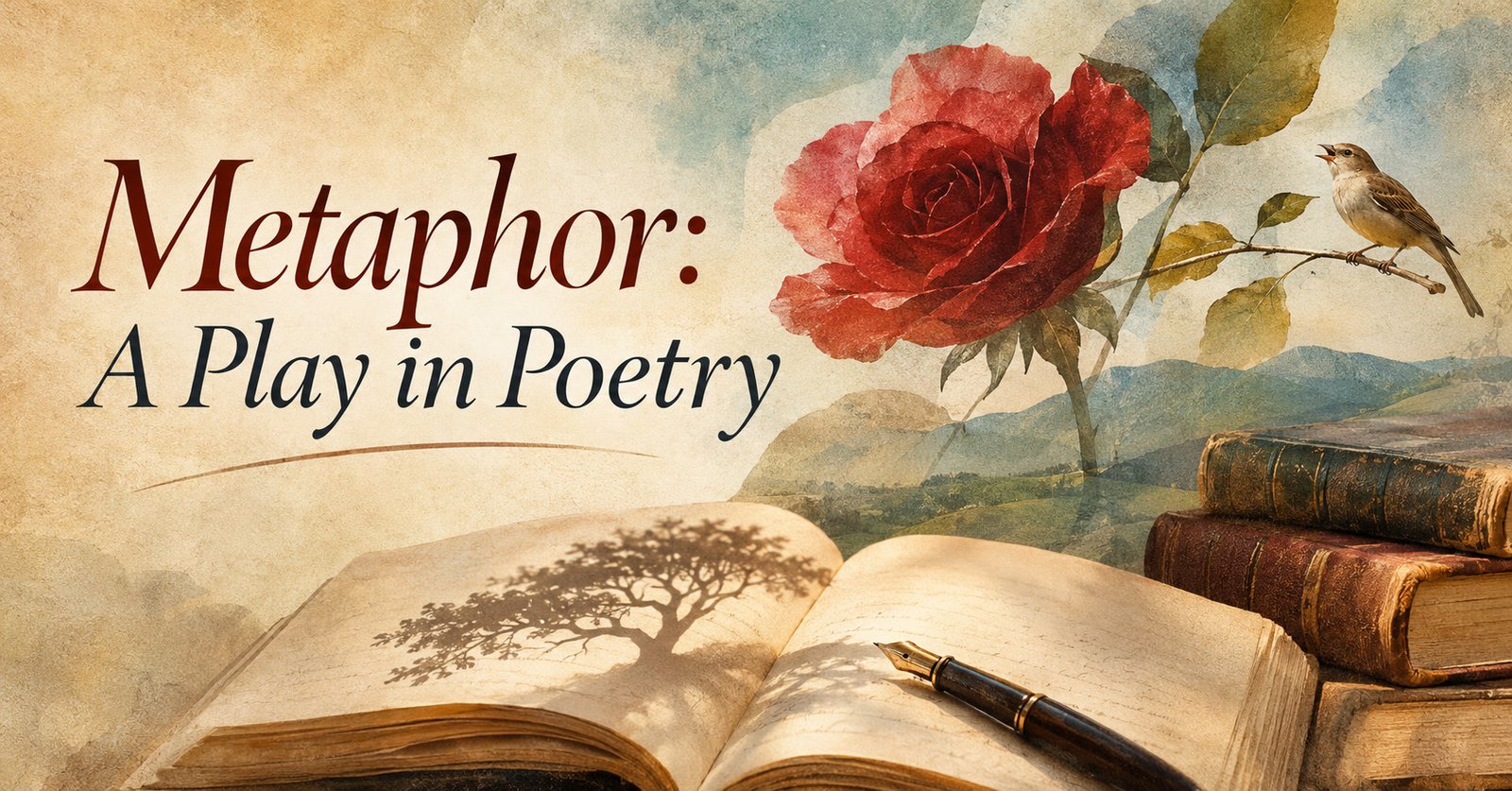
Metaphor is an ornament of poetry. It lends to the word to which it gets associated clarity and exactitude. How does it achieve the desired result? By deft use of comparison, of course. It uses comparison to embellish the word and to give deeper insight into what the word signifies. It is a natural and artistic technique by which the poet associates words and ideas. Many people view the power of the metaphor as the ability of the poet to visualize the similiarity in dissimiliar objects and phenomena. By the apt use of metaphor the poet touches and manages to sustain the readers interest, Suggestiveness becomes the essence of the textual reference. In a half playful fashion Robert Frost wrote about metaphor as “the one possible way of saying one thing and meaning another.”
Metaphor is a lively and illuminating play of wit in which both writer and reader conspire to rise above the reality. In a metaphor, the wit of the writer and that of the reader are matched. Louis Untermeyer in his brilliant essay ‘Play in Poetry’ — written on February 26, 1938 (for full essay please refer to The Saturday Review Treasury, published 1957) — expanded the theme with these catchy words: “The mind of the poet fastens on an object and then rushes halfway across the world to establish a relation between that object and some hitherto unrelated object. Although the objects are not in the least alike, the reader is quick to see the likeness at the point of comparison. My love, says the poet, is like — and, in the spirit of play, he looks about him for something resembling his lady as little as possible — like, he announces triumphantly, a red, red rose. To the solemn scientific eye there is no reasonable resemblance between the figure of a woman and the shape of a rose. But the reader is as litte interested in laboratory realism as is the poet. It is an intellectual game, this saying one thing and meaning another, a verbal sportiveness; the poet points the way, and the reader’s mind romps along.”
Metaphor In Practice
“Even while he scorns poetry, the ordinary man helps himself to its properties and symbols; his daily life is unthinkable without metaphor. Having slept ‘like a log,’ he gets up in the morning ‘fresh as a daisy’ or ‘fit as a fiddle’; he ‘wolfs down’ breakfast, with his wife, who has a ‘tongue like vinegar,’ but ‘a heart of gold.’ He gets into his car, which ‘eats up the miles,’ steps on the gas, and, lets it ‘purr’ along through the ‘hum’ of traffic; he reaches his office where he is ‘as busy as a one-armed paper- hanger with the hives.’ Life, for the average man is not ‘a bed of roses,’ his competitor is ‘sly as a fox’ and his own clerks are ‘slow as molasses in January.’ But ‘the day’s grind’ is finally done and, though it is ‘raining cats and dogs,’ he arrives home ‘happy as a lark.'”
Note how the romantic poet William Blake applies metaphor in one of his compositions :
Bring me my bow of burning gold!
Bring me my arrows of desire!
Bring me my spear!
O clouds unfold! Bring me my chariot of fire!
I will not cease from mental fight,
Nor shall my sword sleep in my hand,
Till we have built Jerusalem In England’s green and pleasant land.
Caution
“A poem must not mean, but be…”
— Archibald MacLeish
Remember, metaphor is an ornament. Use of this figurative form should be judicious. The beauty and force of composition very much depends on its judicious use. Ornaments are used for the decoration of ideas. The excessive employment of ornaments makes writing all show, no substance.The worth of a man is to be estimated not by his gems and jewellery but by his deeds and achievements. Similarly, the worth of a composition depends more on ideas and message than on mere figurative embellishment.
Poem using Metaphor
Yearning
by Kingshuk Das Gupta
The doors swing and swing
Near to far horizon mo’ing
East and West, far and wide
North and South all ‘re bright.
The doors flap and I see —
Hill top and green tree,
Bird’s nest, flower with bee
Down to earth and sea.
Owe to parents who set
The door and open’d
The gate to peep thru’,
And see all that grew.
I would see ‘ere that in a train
Setting the eyes on window, not using brain.
What e’er mo’ing fall on frame
Eyes never fail to catch the same
All ‘re snaps and not e’en shots
While eye satiates heart revolts.
I not only see now,
Observe I anything new too–
Appearance to essence of things
Wood to plants and to sprigs.
The doors swing and swing
I see, observe and, longing
Man with all vigil
To feel, feel and feel!
The world around us
Whate’er grey and fuss,
To alter and transfer;
And hearts to come closer and closer!
Note: Metaphors used in the poem is given in italics. eg ‘doors’ relate to eyelids and ‘gate’ relates to eye.
Question
Here are some quotes. Can you point out the metaphor(s) used in each quote and the name of the writer.
- Variety is the spice of life.
- Hope is the brightest when it dawns from fear
- The tree of liberty only grows when it is watered by the blood of tyrants.
- I bridle in my struggling Muse with pain,
That longs to launch into a bolder strain. - Here lay Duncan, his silver skin laced with his golden blood.
- Failures are but pillars to success.
- Behaviour is a mirror in which everyone shows his image.
- There is always room at the top.
- Knowldege is a great wealth. It cannot be shared by Kinsmen, or stolen by thieves. It remains intact though given to others.
- A man without patience is a lamp without oil.
Answer
- Variety is the spice of life.
Metaphor — spice; Writer — Cowper - Hope is the brightest when it dawns from fear.
Metaphor — dawns; Writer — Scott - The tree of liberty only grows when it is watered by the blood of tyrants.
Metaphor — grows, watered; Writer — Barere - I bridle in my struggling Muse with pain,
That longs to launch into a bolder strain.
Metaphor — bridle, launch, strain; Writer — Addison - Here lay Duncan, his silver skin laced with his golden blood.
Metaphor — laced, golden; Writer — Shakespere - Failures are but pillars to success.
Metaphor — pillars; Writer — Scadi - Behaviour is a mirror in which everyone shows his image.
Metaphor — mirror; Writer — Goethe - There is always room at the top.
Metaphor — room; Writer — Daniel Webster - Knowldege is a great wealth. It cannot be shared by Kinsmen, or stolen by thieves. It remains intact though given to others.
Metaphor — wealth; Writer — Chanakya - A man without patience is a lamp without oil.
Metaphor — lamp; Writer — Andreas Segoria
(First published in Meghdutam.com between 1998 – 2003)