

With the rise of digital platforms and independent publishing models, authors can now self-publish in India on their own terms. What was once considered a fallback option has become a powerful, strategic route that offers control, speed, and ownership.
For a long time, becoming a published author in India depended on approval; approval from publishers, editors, and a system that often prioritized market trends over unique voices. Many talented writers found themselves waiting months, sometimes years, for responses that never came.
Today, that landscape has changed dramatically with the rise of self-publishing. If you’re wondering how to self-publish a book in India step by step, what it costs, and which platforms to choose, this guide covers everything you need to get started.
While this opportunity is exciting, the process itself can feel overwhelming. From editing and design to distribution and marketing, there are multiple decisions to make, and each one impacts the success of your book.
This guide is designed to simplify that journey. Whether you’re a first-time writer or someone ready to take your manuscript seriously, here’s everything you need to know to move from idea to published book with confidence.
What is self-publishing in India?
At its core, self-publishing means taking ownership of the entire publishing process. Instead of submitting your manuscript to a traditional publisher and waiting for acceptance, you independently bring your book to life, while retaining full rights and creative control.
This shift is significant. In traditional publishing, authors typically earn a small royalty and have limited say in how their book is edited, designed, or marketed. In self-publishing, those decisions belong to you.
This model is especially appealing in today’s India, where a diverse range of voices, from poets and regional writers to entrepreneurs and educators, are finding audiences that traditional systems often overlook.
Self-publishing is about redefining what it means to be an author in a modern, digital-first world.
Self-publishing vs traditional publishing
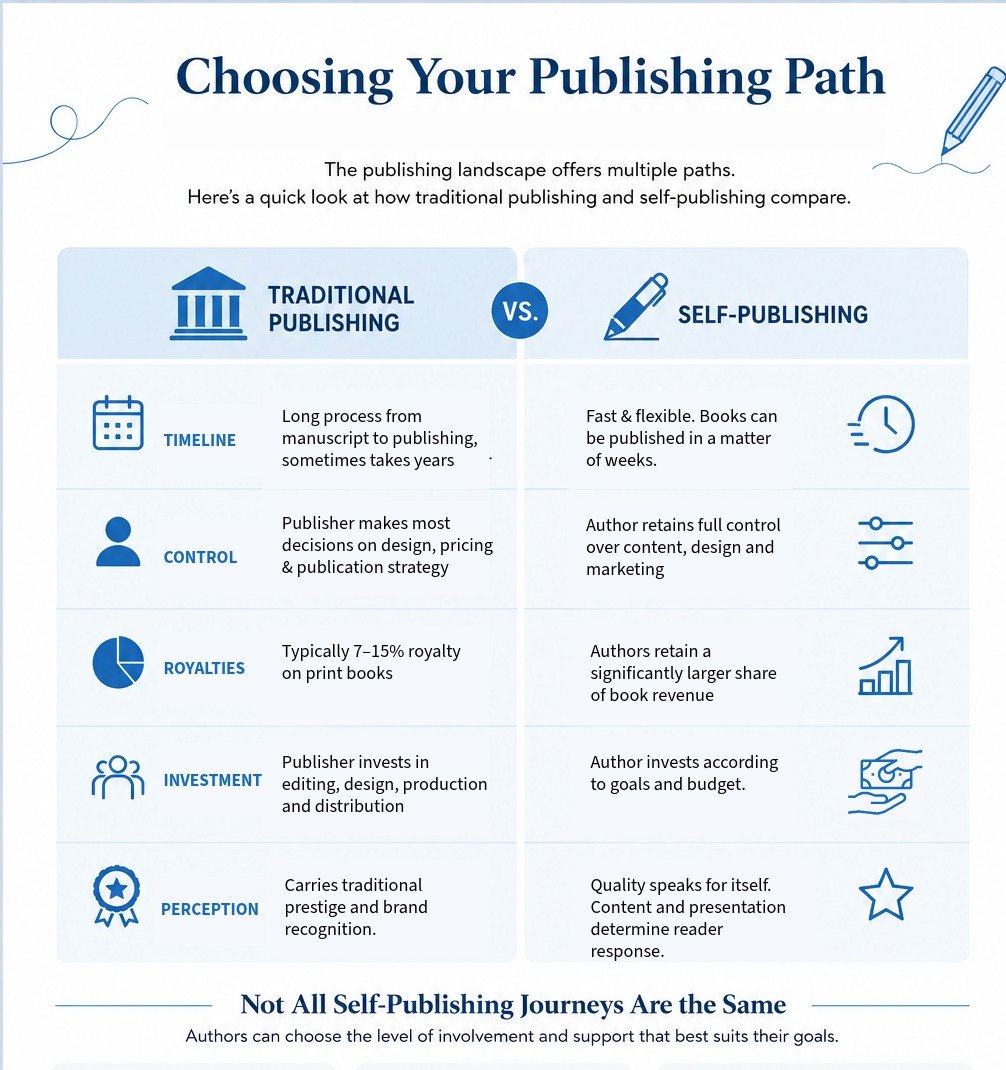
The contrast between traditional and self-publishing has never been clearer.
Traditional publishing still offers prestige and structured support, but it comes with long timelines and limited flexibility. It’s not uncommon for the process to take over a year, with multiple stages of approval before a book even reaches production.
Self-publishing, on the other hand, is built for speed and control. Authors can bring their books to market in a matter of weeks, retain a much larger share of royalties, and make decisions that align with their creative vision.
However, this independence comes with responsibility. Every aspect of the book, from editing quality to cover design, directly affects how readers perceive it. In that sense, self-publishing is more than a creative process; it’s a professional one.
While self-publishing gives you full control, not all publishing journeys are the same. Some authors prefer a do-it-yourself approach, while others look for structured, professional support to ensure their book meets industry standards.
In recent years, a more quality-focused, editorial-driven approach has also emerged, combining the independence of self-publishing with the rigor of traditional publishing.
Step-by-step process to self-publish a book in India
Publishing a book is a sequence of thoughtful steps, each contributing to the final outcome. Understanding this process helps you avoid common mistakes and ensures that your book meets professional standards.
Finalizing your manuscript
Everything begins with the manuscript, but finishing a draft is only the beginning. A manuscript that is ready for publication is one that has gone through multiple rounds of refinement. It should have clarity in structure, consistency in tone, and a clear sense of purpose.
Many authors underestimate this stage, but taking the time to refine your manuscript can dramatically improve how your book is received.
If you’re unsure whether your manuscript is ready, a professional review can help identify structural gaps before moving to the next stage.
Editing: the foundation of a professional book
Editing is often the most overlooked and most important step in self-publishing.
A well-edited book doesn’t just eliminate grammatical errors; it enhances readability, strengthens your voice, and ensures that your ideas are communicated effectively.
Developmental editing helps shape the structure and flow, while copyediting refines language and clarity.
Proofreading, the final stage, ensures that the book is polished before it reaches readers.
Skipping this step may save money upfront, but it often results in poor reviews and lost credibility.
Formatting: turning content into a reading experience
Formatting determines how your book reads. It includes everything from font choices and spacing to chapter layouts and margins.
A poorly formatted book can frustrate readers, no matter how strong the content is. On the other hand, a clean and professional layout enhances readability and proves quality.
It’s also important to note that formatting requirements differ depending on whether your book is being published as an eBook or a paperback, particularly on platforms like Amazon KDP India.
Cover design: your first impression
Your book cover is your most powerful marketing tool.
In an online marketplace, readers often make decisions within seconds. They scroll through options, and your cover is what makes them pause. A strong cover immediately communicates genre, tone, and professionalism.
More importantly, it builds trust. Readers are far more likely to engage with a book that looks professionally designed. In contrast, a poorly designed cover, even with excellent content inside, can significantly reduce your chances of being noticed.
For further reading, check out our blog, The Strategic Role of Book Cover Design in Publishing Success
ISBN registration in India
An ISBN is essentially your book’s identity in the global publishing ecosystem. It allows your book to be cataloged, tracked, and distributed across platforms.
In India, ISBNs are issued free of cost through the Raja Rammohun Roy National Agency. While the process is straightforward, many authors choose to have it handled by publishing partners as part of a larger service package.
To apply for an ISBN in India, you need to submit your manuscript details through the official ISBN portal along with basic author information. Once approved, the ISBN can be used to list your book across platforms and retail channels. While the process is free, it may take a few days to weeks, depending on application volume.
Choosing the right publishing approach
At this stage, authors must decide how they want to publish.
Some choose a fully DIY route using platforms like Amazon KDP, which offers maximum control but requires technical involvement. Others opt for self-publishing packages, where services such as proofreading, editing, design, formatting, and distribution are available based on what the author chooses to purchase.
An affordable and suitable alternative is Assisted Publishing, offered by Blue Pencil. It is a guided approach that combines the independence of self-publishing with professional support. Here, authors retain full control over their work while benefiting from essential value-added services like proofreading, structured formatting, and professional design, ensuring the final book is polished and presentation-ready.
For authors who want their work to be taken seriously, this approach provides a balance between independence and professional guidance. Assisted Publishing differs from regular self-publishing in a critical way. It ensures that your book, when printed, is error-free, professionally designed, affordably priced and available in national and international online marketplaces such as Amazon and others. One must remember that unlike a blog or ebook, which can be updated as many times as you wish, a printed book is a finished product. If your book is replete with typos, irregular formatting and messy or dry layout, it will mar your efforts as the author.
If you are comfortable managing technical steps, DIY platforms work well. However, if your priority is professional quality and ease, working with a publishing partner can significantly simplify the process.
Publishing and distribution
Once your files are ready, the publishing process involves uploading your manuscript, setting up metadata, and selecting distribution channels.
Modern self-publishing relies heavily on print-on-demand technology, which eliminates the need for large upfront printing costs. Books are printed only when ordered, making the process both efficient and scalable.
Through platforms like Amazon and Flipkart, your book can reach readers across India and even globally without traditional logistical barriers.
Understanding the cost of self-publishing a book in India
One of the most common questions aspiring authors ask is: how much does it actually cost to self-publish a book in India?
The answer depends on the level of editorial support your manuscript requires and the quality of publishing you are aiming for.
At a basic level, many DIY platforms may offer publishing at very low costs. However, these often exclude critical elements such as professional editing, design quality, and structured distribution, factors that directly impact how your book is received.
In a more professional, editorial-driven publishing model, costs are structured differently.
At Blue Pencil, publishing packages typically start at ₹64,990, with more comprehensive packages starting at ₹88,990, and premium publishing experiences ranging up to ₹1,98,900 and above, depending on the scope of editorial work and production requirements.
These packages include essential components such as:
- Professional cover design
- Professional interior layout and formatting
- Proofreading
- ISBN allocation
- Distribution across platforms like Amazon and Flipkart
- Author copies
While proofreading (an essential service to ensure an error-free book) is part of the package, comprehensive editorial work (copy editing or developmental editing) is treated separately. This ensures that your manuscript receives the level of attention it truly needs, whether that is basic proofreading or deeper copy editing.
The difference between typical self-publishing and Blue Pencil’s Assisted Publishing lies in how the manuscript is finalized before it reaches readers. In most self-publishing models, essential steps like proofreading and formatting are either minimal or charged as add-ons, often resulting in books that feel unpolished or inconsistent in structure.
At Blue Pencil, we ensure that every manuscript goes through careful basic proofreading and is formatted thoughtfully based on the content it carries. From clean layouts to consistent styling, the focus is on creating a reading experience that feels professional and complete. This means that even at a foundational level, your book is not just published, but presented in a way that reflects clarity, care, and credibility.
For most first-time authors, choosing the right level of editorial support is more important than choosing the lowest cost, because it directly influences how readers experience your book.
Self-publishing vs assisted publishing: What’s the real difference?
While the term “self-publishing” is widely used, it often covers a broad spectrum of quality. In many cases, self-publishing platforms focus primarily on making a book available, with limited attention to editorial depth, formatting precision, or overall reading experience. The result is often a book that is technically published, but not necessarily positioned to compete in the market.
Assisted publishing, on the other hand, bridges the gap between independence and professionalism. It retains the author’s control and ownership, while introducing structured support across key stages such as editing, design, formatting, and production.
The difference ultimately shapes the outcome, how the book reads, feels, and is received by its audience. A typically self-published book may reach the market quickly, but an assisted-published book is shaped with the intent to meet professional standards, ensuring it is not only available but also credible, readable, and ready to be taken seriously by its audience.
How long does it take to self-publish a book in India?
One of the biggest advantages of self-publishing is speed.
While traditional publishing can take over a year, self-publishing timelines are significantly shorter. Most books can be brought to market in 30 to 90 days, depending on the level of editing and design.
This allows authors to move quickly, respond to trends, and maintain momentum, something that is increasingly valuable in today’s fast-paced content landscape.
Is self-publishing profitable in India?
Self-publishing can be profitable, but it requires the right approach.
Unlike traditional publishing, where royalties are limited, self-published authors can earn significantly more per copy. However, profitability depends on several factors, including pricing, quality, and marketing.
A well-positioned book with strong reviews and visibility can recover its investment and generate consistent returns. On the other hand, a poorly executed book, regardless of content, may struggle to find readers.
In that sense, profitability is closely tied to the decisions you make throughout the publishing process.
The role of marketing in self-publishing success
Publishing a book is only half the journey. The other half is ensuring that it reaches readers.
Many authors assume that once a book is published, it will naturally find its audience. In reality, visibility must be built.
This includes optimizing your book’s listing on Amazon, gathering early reviews, building a presence on social media, and planning a launch strategy. Even simple actions, such as choosing the right keywords or categories, can significantly impact discoverability.
Marketing doesn’t have to be overwhelming, but it does need to be intentional.
Common mistakes first-time authors make
One of the biggest reasons self-published books fail is not the idea, but the execution. Many authors rush to publish without investing in editing or design, assuming that content alone will carry the book.
Another common mistake is choosing platforms based only on cost, without evaluating quality or long-term positioning. Ignoring marketing is also a major gap, as visibility plays a crucial role in book sales.
Avoiding these mistakes can dramatically improve both the quality and success of your book.
Choosing the best self-publishing company in India
With so many options available, choosing the right publishing partner can be challenging.
What matters most is not just what services are offered, but how they are delivered. Transparency, editorial quality, and long-term support should be key considerations.
A critical factor to evaluate is whether the publisher prioritizes quality or volume. Many platforms focus on speed, but fewer invest in editorial rigor and long-term author success.
A good publishing partner helps shape the book; they bring structure, expertise, and professionalism that ensure your work stands out in a crowded marketplace.
A better way to approach self-publishing
One of the biggest misconceptions about self-publishing is that it’s simply about getting your book printed.
In reality, publishing is about positioning. It’s about how your book is perceived, how it competes, and how it connects with readers.
This is where the difference between transactional publishing and quality-driven publishing becomes clear.
Authors who treat their book as a serious project rather than a quick output tend to invest more thoughtfully in editing, design, and strategy. And in doing so, they create books that not only get published but get noticed.
Your journey as an author starts here
There has never been a better time to self-publish in India. The tools are accessible, the platforms are powerful, and the opportunities are growing every year.
But success in self-publishing doesn’t come from simply following steps. It comes from making informed decisions about quality, positioning, and the kind of book you want to create.
If you’re looking for guidance, clarity, and a publishing experience that prioritizes quality, working with the right partner can make all the difference.
Book a free consultation with Blue Pencil and take the first step toward turning your manuscript into a professionally published book that truly reflects your vision.
Frequently Asked Questions
1. How do I publish my own book in India?
To publish your own book in India, start by finalizing your manuscript, then invest in professional editing and design. Next, register an ISBN, choose a publishing platform like Amazon KDP India or an assisted publisher, upload your files, and make your book available through online distribution channels such as Amazon and Flipkart.
2. How much does it cost to self-publish a book in India?
The cost of self-publishing in India typically ranges from ₹5,000 to ₹3,00,000, depending on the level of services you choose. A basic DIY setup is low-cost, while professional editing, design, and marketing support increase the investment but significantly improve book quality and sales potential.
3. Is self-publishing profitable in India?
Yes, self-publishing can be profitable in India if approached strategically. Authors earn higher royalties compared to traditional publishing. Profitability depends on factors like content quality, pricing, marketing efforts, and visibility on platforms like Amazon.
4. Which is the best self-publishing company in India?
The best self-publishing company in India depends on your goals. Platforms like Amazon KDP are ideal for DIY publishing, while assisted publishers like Blue Pencil offer support with editing and design. Authors seeking higher quality and professional guidance often choose publishers to focus on editorial standards and long-term positioning.
5. How long does it take to self-publish a book in India?
Self-publishing a book in India typically takes between 45 to 90 days. The timeline depends on factors such as editing, cover design, formatting, and platform approvals. Compared to traditional publishing, this process is significantly faster and allows authors to bring their work to market quickly.
6. Do I need an ISBN to self-publish in India?
Yes, an ISBN is required to distribute your book through major platforms and bookstores. In India, ISBNs are issued free of cost by the Raja Rammohun Roy National Agency. Many self-publishing companies also assist authors in obtaining and assigning ISBNs.
7. How do I distribute a self-published book in India?
Self-published books in India are primarily distributed through online platforms like Amazon and Flipkart using print-on-demand technology. This ensures your book is printed only when ordered, eliminating inventory costs while enabling nationwide and global availability.
8. Can I self-publish a book in India on Amazon KDP?
Yes, authors in India can easily self-publish on Amazon KDP. The platform allows you to publish both eBooks and paperbacks, set your pricing, and reach readers across India and globally. However, you are responsible for formatting, cover design, and marketing if you choose the DIY route.